
GREENKEEPER BLOG

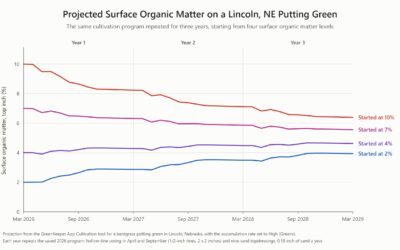
Hi-Res Surface Organic Matter Analysis in GreenKeeper

Surface organic matter has always been one of the most important—and frustrating—variables to manage on putting greens. We know it influences firmness, infiltration, water holding capacity, and pest pressure. We also know that topdressing and cultivation are our...

Why Your Rainfall Data May Be Wrong: The Challenges of Estimated Precipitation

GreenKeeper, like the weather apps on your phone, uses extremely high-resolution weather models to estimate current conditions and forecast future weather. These systems combine observations from airports, weather balloons, satellites, and weather radar with...

A Completely New WhiteBoard Experience for Turf Managers

GreenKeeper WhiteBoard has been rebuilt from the ground up with a modern user experience, intelligent planning tools, and unmatched flexibility for daily turf operations.Daily labor planning in turf management is complicated. Every day, turf managers balance changing...

Your Spray Program Shouldn’t Keep You Up at Night

​Building a spray program can be stressful. You're thinking about pest control, fertility, PGRs, wetting agents, and plant health products. Are products from the last application still doing the job? Then comes the mixing math. A misplaced decimal or a wrong unit can...

Moving Beyond Pretty Maps

Today's weather forecast shows a 10% chance of rain in the late morning. Do you throw your rain gear in the cart? What if the forecast shows a 30% chance at 7:00 a.m.? Even without formal training in statistics, we use probabilities like these to make practical...

GreenKeeper Models Provide More Insight Than Simple GDD Calculators

​I first learned about growing degree days (GDDs) in my introductory agronomy course at UW–Madison. These models used daily average temperature to predict biological processes such as corn development. I later learned that GDDs could also be used to schedule seedhead...

Upgraded GreenKeeper CIS Includes POGO Integration

Many turf management decisions are inherently spatial—where water is needed, where pests typically occur, and where additional management is required to achieve specific performance goals. Historically, these patterns have been managed through careful observation,...

Learning the Microclimate: GreenKeeper Insight Improves Forecast Accuracy

Accurate weather forecasts are central to irrigation scheduling, spray timing, and stress management, yet most forecasts are built for regions—not individual golf courses or athletic complexes. Terrain, tree cover, elevation, and nearby bodies of water create...

Move Past Yesterday’s ET: The Predictive Advantage of GreenKeeper wX

Agronomic models are only as good as the data they receive. GreenKeeper’s models rely on high-quality, site-specific weather inputs to perform at their best. Adding a wX station dramatically improves the accuracy and resolution of those data. While weather stations...

Invest in Yourself and Staff with GreenKeeper University

Advance your turf management knowledge at your pace with GreenKeeper University. Our team of renowned turfgrass professors, researchers and practitioners have created 18 different online courses to help advance the knowledge of turfgrass managers. Students can enroll...
Your Spray Program Shouldn’t Keep You Up at Night

Your Spray Program Shouldn’t Keep You Up at Night

​Building a spray program can be stressful. You're thinking about pest control, fertility, PGRs, wetting agents, and plant health products. Are products from the last application still doing the job? Then comes the mixing math. A misplaced decimal or a wrong unit can...

read more
Moving Beyond Pretty Maps

Moving Beyond Pretty Maps

Today's weather forecast shows a 10% chance of rain in the late morning. Do you throw your rain gear in the cart? What if the forecast shows a 30% chance at 7:00 a.m.? Even without formal training in statistics, we use probabilities like these to make practical...

read more